How Often Do People Blink? Complete Guide
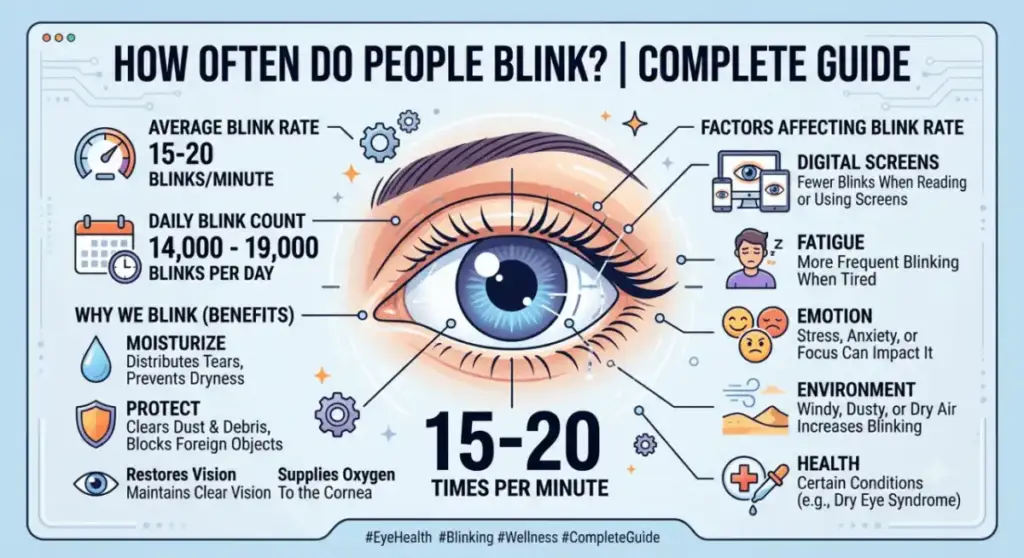
Most people blink 15 to 20 times per minute, helping keep their eyes moist and protected.
Blink right now. Did you feel it? Probably not. That’s the whole point of blinking — it just happens.
Most of us never think about it until someone asks, “wait, how often DO we blink?” Then suddenly you’re aware of every blink for the next ten minutes. Sorry about that.PriceLabs News November
Here’s the short version: you blink somewhere between 15 and 20 times a minute. Over a full day, that adds up to roughly 14,000 to 19,000 blinks. Your eyes are working way harder than you give them credit for.
The Quick Numbers
| Time | Blinks |
|---|---|
| 1 minute | 15–20 |
| 1 hour | 900–1,200 |
| A waking day (~16 hrs) | 14,000–19,000 |
These are averages. Your own number depends on what you’re doing, how tired you are, and even how much time you spend staring at screens.
What’s Actually Happening When You Blink
A blink is your eyelid closing and opening again. That’s it in plain terms. But it happens fast — about a third of a second — and it takes coordination between your brain, nerves, and eye muscles to pull off.
You don’t plan most of your blinks. Your brain just handles it in the background, the same way it handles breathing.
Why Your Eyes Bother Blinking So Much
There’s a reason blinking happens this often instead of, say, twice an hour. A few reasons, actually.
It keeps your eyes wet. Every blink pulls a thin layer of tears across your eye. Without that, your eyes dry out fast.
It clears out junk. Dust, eyelashes, tiny particles — blinking sweeps them away before they cause real irritation.
It’s a reflex too. Bright light, wind, or something flying toward your face can trigger a blink instantly, no thought required.
It might even help your brain reset. Some research suggests blinking gives your brain a tiny break in attention, almost like a mental pause button.
What Changes How Often You Blink
Not everyone blinks the same amount, and even you don’t blink the same rate all day. A bunch of things push that number up or down.
Screens Slow You Down
This one’s big. When you’re staring at a phone, laptop, or TV, your blink rate can drop to 5–10 times a minute — sometimes even less. You get so focused on the screen that your brain just… forgets to blink as often.
That’s a big part of why your eyes feel gritty or tired after a long work session or a gaming binge.
Reading Does the Same Thing
Books aren’t screens, but reading has a similar effect. Your eyes lock onto the text and blinking takes a back seat.
Age Plays a Role
Kids tend to blink less than adults. As you get older, your blink rate generally climbs.
Stress and Fatigue Show Up in Your Blinking
Feeling anxious? You might blink more. Running on no sleep? Your blink pattern can shift too, and not always in a way that helps.
Certain Meds and Eye Conditions Matter
Some medications alter blink rate as a side effect. Dry eye and other eye conditions can push you to blink more often, since your eyes are trying to compensate.
Blink Rate by Activity
| What you’re doing | Blinks per minute |
|---|---|
| Just relaxing | 15–20 |
| Talking to someone | 20–30 |
| Reading | 5–10 |
| Working on a computer | 5–10 |
| Watching videos | 5–15 |
| Sleeping | 0 (eyes shut the whole time) |
Notice the pattern? Anything that demands visual focus tends to cut your blink rate in half or more.
The Three Types of Blinks
Not every blink is the same kind.
Spontaneous blinks are the automatic ones — no trigger, no thought, just your body doing its thing.
Reflex blinks kick in when something startles or threatens your eye, like a puff of air or sudden bright light.
Voluntary blinks are the ones you choose, like when you wink or deliberately close your eyes for a second.
Why This Actually Matters for Your Eye Health
Skipping blinks isn’t just a minor habit issue. It has real consequences.
When you blink less than you should, your tear film doesn’t get refreshed. That leads to dryness, irritation, and sometimes blurry vision that clears up the moment you blink a few times.
Office workers who stare at monitors all day are a textbook example. Studies on this have found people can drop to just 5–7 blinks a minute during focused screen work — less than half the normal rate.
Over time, that pattern contributes to what eye doctors call digital eye strain. Dry, tired, achy eyes by the end of the workday? That’s often why.
How to Blink Better (Yes, That’s a Real Thing)
You can’t force yourself to blink more all day, but you can build habits that protect your eyes.
Try the 20-20-20 rule. Every 20 minutes, look at something 20 feet away for 20 seconds. It gives your eyes a real break from close-up focus.
Blink fully, not halfway. A lot of people do a lazy half-blink that doesn’t spread tears properly. Close your eyes all the way, then open.
Take actual screen breaks. Step away from the monitor every so often instead of pushing through for hours straight.
Drink enough water. Dehydration affects tear production more than people realize.
Fix your lighting. Harsh glare or dim rooms make your eyes work harder and strain faster.
Mistakes That Make Things Worse
A few habits sneak up on people and quietly wreck their eye comfort.
Ignoring dry eyes until they’re painful is a common one. So is working under bad lighting for hours without noticing. And skipping breaks because you’re “in the zone” — that one gets almost everybody at some point.
Quick Answers to Common Questions
Do people blink every few seconds?
Yes, roughly every 3 to 4 seconds on average.
How many times do people blink in a day?
Somewhere around 14,000 to 19,000, though it varies person to person.
Does using your phone reduce blinking?
Yes. Screen use is one of the biggest blink-rate killers.
Can blinking too little actually cause dry eyes?
Yes, and it’s more common than people think, especially with heavy screen use.
Do children blink less than adults?
Generally, yes. Blink rate tends to increase as we age.
Do people blink at all while sleeping?
No. Your eyes stay closed the entire time, so there’s nothing to blink.
Can stress make you blink more?
For a lot of people, yes. Anxiety and blink rate are connected.
The Bottom Line
You blink about 15 to 20 times a minute without ever thinking about it, and that adds up to thousands of blinks a day protecting your eyes. Screens, reading, stress, and age all nudge that number around.
The takeaway isn’t complicated: pay attention to your blinking when you’re on screens, take real breaks, and blink fully instead of halfway. Your eyes will thank you by the end of the day.