Car Won’t Start But All Lights Come On A Technology Guide to Modern Vehicle
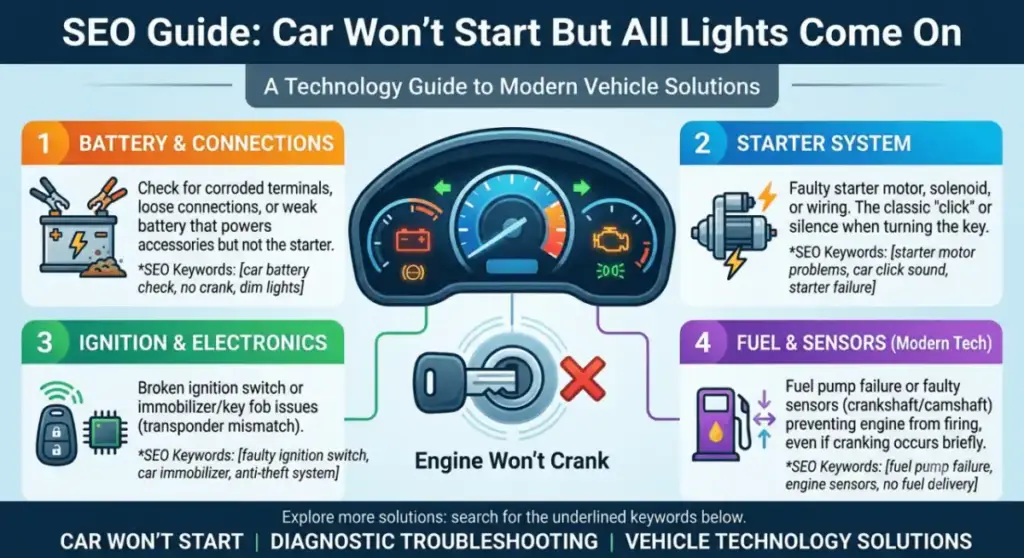
Modern vehicle technology can power dashboard lights even when a battery, starter motor, or ignition system issue prevents the engine from starting.
Car Won’t Start But All Lights Come On
You turn the key. The dash lights up. The radio kicks on. Everything looks normal.
Then nothing. The engine just won’t turn over.
If your car won’t start but all lights come on, you’re not alone. It’s one of the most common complaints mechanics hear, and it trips people up because it doesn’t make sense at first. If the lights work, the battery must be fine, right?
Not exactly. Let’s get into why this happens and how to actually fix it.Filimin App
Why Lights Working Doesn’t Mean Your Battery Is Fine
Here’s the thing most people don’t realize: your headlights and dashboard don’t need much power to run. Your starter motor needs a lot more.
Think of it like this. A weak battery can still push enough juice to light up a few bulbs. But asking that same battery to crank a heavy engine is a completely different job. It’s like a phone with 5% battery — it’ll still turn on and show you the lock screen, but try to open a demanding app and it might just die.
So yes, a car can have working lights and a dead-ish battery at the same time. This is actually the number one reason cars won’t start even though everything else seems powered up.
The Main Reasons Your Car Won’t Start
A Battery That’s Weak, Not Dead
This is by far the most common culprit. A battery doesn’t have to be completely flat to cause a no-start. It just needs to be too weak to handle the sudden power draw of the starter motor.
Watch for these signs:
- A clicking noise when you turn the key
- Slow, sluggish cranking
- The car starts sometimes but not others
If any of that sounds familiar, your battery is probably the issue.
Corroded or Loose Battery Terminals
Even a perfectly good battery can fail to deliver power if the connections are dirty or loose. Corrosion builds up on the terminals over time and it blocks the flow of electricity.
Look for a white, chalky buildup around the terminals. That’s usually the first clue.
A Bad Starter Motor
The starter motor is the part that physically spins your engine to get it running. When it goes bad, your lights and electronics keep working just fine because they run on a separate part of the circuit.
If you turn the key and hear a single click or nothing at all, the starter could be the problem.
A Faulty Starter Relay
The relay is basically a switch that tells the starter motor when to fire up. It’s a small, cheap part, but when it fails, it can stop your car cold even though the battery is perfectly healthy.
Ignition Switch Problems
Newer cars rely on electronic ignition switches instead of the old-school mechanical ones. When this switch wears out or glitches, it can fail to send the signal that starts your engine, even while every other system stays lit up.
A Glitch in the Engine Control Unit (ECU)
Your ECU is basically your car’s brain. It manages fuel delivery, ignition timing, and dozens of other functions behind the scenes.
Occasionally, a software hiccup or a damaged wire in this system can block the engine from starting altogether, without affecting your lights or dashboard at all.
Fuel Pump Failure
If your engine cranks but won’t actually start and run, the fuel pump is worth checking. No fuel reaching the engine means no combustion, no matter how strong your battery is.
Security System Interference
Modern cars come loaded with anti-theft tech: immobilizers, smart keys, that sort of thing. If your car’s computer doesn’t recognize your key for some reason, it can block the engine from starting as a safety measure, even though your lights work perfectly.
Three Types of No-Start Problems
Not every no-start situation looks the same. It usually falls into one of these categories.
No crank, no start. You turn the key and nothing happens, not even a sound. This usually points to the battery or starter.
Crank but no start. The engine turns over, you can hear it trying, but it never actually fires up. This is often a fuel or sensor issue.
Starts sometimes, not others. Inconsistent starting usually means a loose connection, weak battery, or failing relay.
Knowing which category you’re dealing with narrows things down fast.
How to Actually Diagnose It Yourself
You don’t need to be a mechanic to figure out what’s wrong. Here’s a simple order to work through.
Check Your Dashboard Warning Lights
Before you touch anything, look at what your dashboard is telling you. A battery symbol, check engine light, or security light can point you in the right direction immediately.
Test the Battery Voltage
Grab a cheap digital multimeter and check the voltage. A healthy battery should read around 12.6 volts. Anything noticeably lower means your battery needs attention.
Look at the Terminals
Pop the hood and check the battery connections. Loose cables or corrosion are easy to spot and even easier to fix.
Listen Closely When You Turn the Key
A single loud click usually means starter trouble. Rapid clicking often means a weak battery. Total silence could mean either one, or something electrical further up the chain.
Run an OBD-II Scan
If your car has a check engine light on, or you just want more information, an OBD-II scanner plugs into a port under your dashboard and pulls error codes straight from your car’s computer. You can find cheap ones online for under $30, and they take the guesswork out of the process.
Check for Fuel Pump Activity
Turn the key to the “on” position without starting the car and listen near the fuel tank. You should hear a faint hum for a couple seconds. Silence there could mean a pump issue.
Don’t Forget the Key Fob
If your car uses a smart key, a dead key fob battery can sometimes prevent the car from recognizing it. Swapping the tiny battery inside the fob is a two-minute fix that people overlook constantly.
Mistakes People Make With This Problem
A few habits make this situation worse instead of better.
People assume working lights mean a healthy battery, then rule it out completely. They ignore dashboard warnings for weeks before dealing with them. Some folks start swapping parts blind, replacing the battery, then the starter, then the alternator, without ever testing anything first.
That approach wastes money and time. A five-minute voltage test can save you from buying parts you didn’t need.
How to Avoid This Happening Again
A little maintenance goes a long way here.
Get your battery tested once a year, especially once it’s past the three-year mark. Clean the terminals every few months if you live somewhere humid or salty in winter. Keep an eye on your dashboard lights instead of ignoring them. And if your battery is pushing 4 or 5 years old, don’t wait for it to strand you somewhere — most batteries only last that long before they start struggling.
It also helps to keep a portable jump starter in your trunk. They’re small, affordable, and can save you from a bad morning.
A Real Example
A friend of mine drives a 2021 sedan. One morning, everything powered up like normal, lights, radio, dashboard, but the engine wouldn’t turn over.
He borrowed a load tester from a nearby auto parts store. The battery showed a normal resting voltage, but the second it was put under load, the reading collapsed. New battery, problem solved, same day.
That’s a textbook example of why “the lights work” doesn’t tell you much on its own.
Quick Comparison of Common Causes
| Cause | Lights Work? | Engine Cranks? |
|---|---|---|
| Weak battery | Yes | No |
| Bad starter | Yes | No |
| Starter relay failure | Yes | No |
| ECU glitch | Yes | No |
| Fuel pump failure | Yes | Yes, but won’t run |
| Immobilizer/security issue | Yes | No |
Tools Worth Having in Your Trunk or Garage
- A digital multimeter — for checking battery voltage in seconds
- An OBD-II scanner — pulls fault codes directly from your car’s computer
- A portable jump starter — no need to flag down a stranger for a jump
- A battery load tester — shows how your battery performs under real strain, not just resting voltage
None of these cost much, and having them on hand turns a stressful morning into a five-minute fix.
Frequently Asked Questions
Why won’t my car start even though all the lights come on? Usually it’s a weak battery that can’t handle the power draw of the starter, even though it has enough juice for lights and electronics.
Can a battery be bad even if the lights still work? Yes. Lights need very little power compared to the starter motor, so a weak battery can run one and fail the other.
What does a clicking sound mean when I try to start my car? It’s typically a sign of a weak battery or a failing starter motor.
Can a computer glitch stop my car from starting? It’s rare, but yes. A fault in the engine control unit can block startup even when every other system looks normal.
How long do car batteries usually last? Most last between three and five years, depending on climate and usage.
Should I replace my battery right away if my car won’t start? Test it first. A load test takes a few minutes and tells you for sure instead of guessing.
Can my car’s security system block it from starting? Yes. If the immobilizer doesn’t recognize your key, it’ll prevent the engine from starting as a theft-prevention measure.
The Bottom Line
A car that won’t start but has working lights almost always comes down to one of a handful of usual suspects: a weak battery, a failing starter, corroded terminals, or occasionally something electronic like the ECU or security system.
The fastest way to figure out which one you’re dealing with is a simple voltage test and a good listen when you turn the key. Skip the guessing and the expensive parts swap. Test first, then fix.